Most of our assessment system was built for a world in which producing a good essay was hard. Writing took time, and the finished essay was decent proof that a student had read, thought and understood. That link is now broken. A chatbot can produce a competent essay in thirty seconds.
Universities have reacted in two ways. Some ban AI. Others buy software that claims to detect it. Both responses feel natural, and both are weak. A ban is hard to enforce and drives use out of sight. Detection tools produce false accusations, and students who write simply, or who write in a second language, are the ones most at risk of being wrongly flagged.
I think the better response is to change what we ask students to do. If an assignment can be completed well without understanding, the assignment is the problem.
Ask what you actually want to know
Every assessment is an indirect way of asking one question: does this person understand the subject? An essay was a convenient proxy. Now we need better proxies, or we need to ask the question more directly.
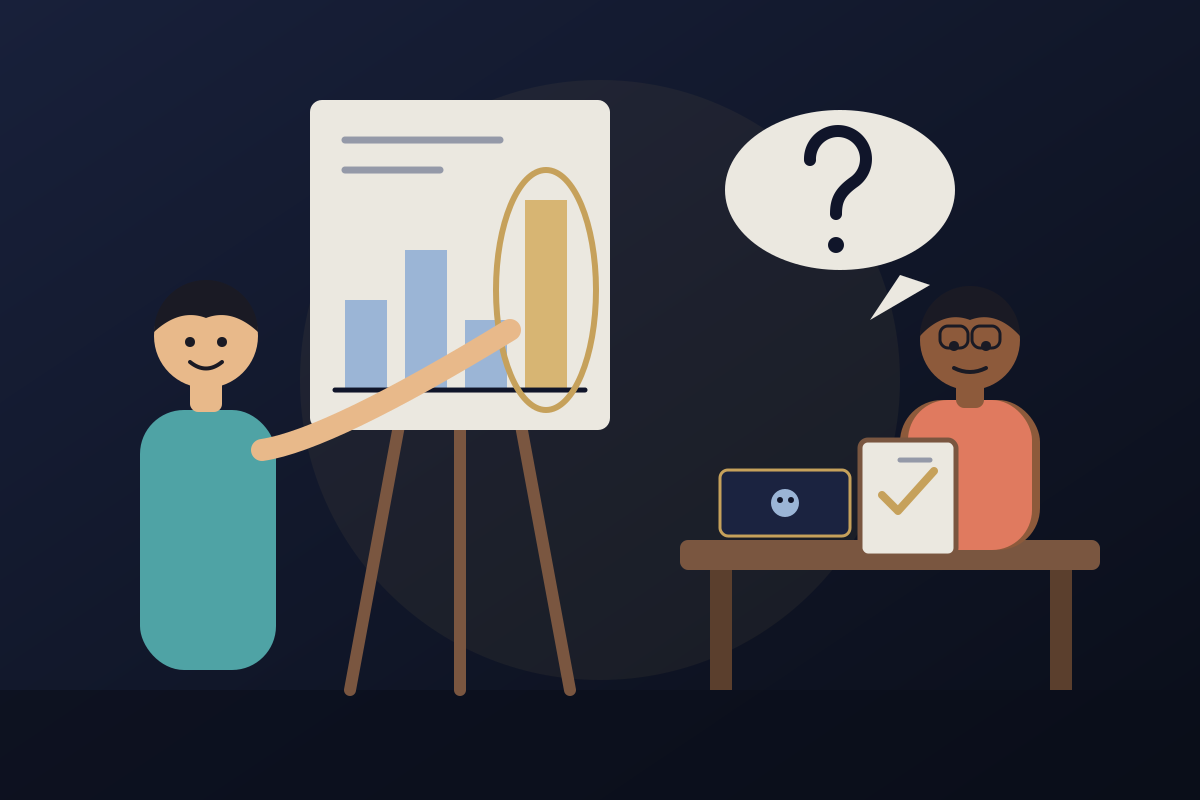
When I teach a short course like the four-day Excel and AI programme at KUSOM, there is no time for long essays. What works is watching people work. A participant builds something on the day, and then explains why they chose that formula or that chart. If they cannot explain it, they have not learned it, whoever or whatever produced the first version. That kind of live, short check is hard to fake and quick to run.
The lesson carries over to a semester course. The final product matters less than the student's ability to talk about it.
There is a useful side effect. When students know they will have to explain their work, they use AI differently. They stop asking it to finish the job and start asking it to help them understand the job. The assessment shapes the behaviour, which is exactly what good assessment should do.
This is not a new idea. Teachers have always asked students to show their working in mathematics. What is new is that we now need to ask for it in every subject, because the finished product alone can no longer carry the proof.
Four designs that hold up
The first is the short oral check. Pick a sample of students, or a sample of questions, and ask the student to explain their own submitted work for five minutes. You do not need to do this for everyone every time. The possibility of being asked changes how students prepare.
The second is work that begins in the room. Start a problem in class, on paper or on a shared screen, so that the first thinking is visibly the student's own. Later work can use AI, but it builds on that base.
The third is local and personal data. Ask students to collect something themselves: interview three shopkeepers in their neighbourhood, record prices at the local market for a week, survey twenty classmates. A chatbot has no access to that data. The student has to deal with real mess, and real mess is where learning happens. This is also close to how I learned field research.
The fourth is the process portfolio. Ask for drafts, notes, the AI conversation and a short reflection on what the student accepted and what they rejected. Grade the reasoning, not only the final text. A student who can say 'the model suggested this, and I rejected it because the sample was too small' is showing exactly the skill we want.
The honest objection: we have large classes
Any lecturer in Nepal will say, fairly, that oral checks and portfolios sound lovely but they teach large classes and have little time. This is the real constraint, and it deserves a real answer.
Sampling is part of the answer. You do not have to listen to everyone. Another part is peer assessment, where students explain their work to each other using a simple rubric. A third is moving routine marking onto AI, with the teacher checking a sample, and spending the saved hours on the small number of conversations that matter most. AI can give the teacher time, and good assessment needs exactly that.
It will not be perfect. But an imperfect system built around understanding beats a perfect-looking system that rewards whoever has the best chatbot.
Start small if you must. Change one assignment this semester, not all of them. Add a five minute conversation to one task. See what you learn about your students that the written work never showed you. Most teachers who try this once do not go back.
Why detection software is the wrong bet
It is worth being direct about detectors. They give a probability, not proof. They can flag honest work and miss dishonest work, and the people who build them say so. A mark, a scholarship or a student's name should never depend on a guess from software.
There is a deeper problem. Detection puts the teacher in the role of police. Every submission becomes a suspect document. Students who did nothing wrong feel watched, and the relationship that makes teaching work starts to break. Even if detectors improve, the models will improve faster, and the contest will not end.
Redesigning assessment is slower, but it ends the contest. When the task itself requires the student to be present, explain and defend, there is nothing left to detect.
One assignment, redesigned
Here is how I would change a common task: a 2,000 word essay on the effects of remittances on a Nepali household. As it stands, a chatbot can write it in a minute.
In the redesigned version, students interview two households in their own community about remittances, with a short guide they prepare in class. They write a 700 word note using their own findings and attach their interview notes. They may use AI to organise ideas and critique the draft, and they attach that conversation. Then each student spends five minutes in a short conversation with me or a peer, explaining one finding and one thing they could not explain.
The result is shorter to read and richer to mark. The student has met real people, handled real mess and learned how to use AI without being replaced by it. Compare that with a clean essay whose author I cannot identify.
Fairness comes first
One more point. Students do not start equal. Some have paid subscriptions to the strongest tools, a laptop at home and a stable connection. Others share a phone. If our rules ignore this, we reward access, not ability.
That argues for doing the key assessments inside the institution, where everyone has the same conditions, and for teaching AI skills openly so that no one is learning them by luck. It also argues against any rule that depends on catching students in the act, because those rules fall hardest on the ones with the least support.
The choice for universities
We can spend the next five years chasing students with detection software, or we can spend them redesigning assessment to reward understanding. The first path exhausts teachers and damages trust. The second is more work now and less work later.
I would rather build assessments where using AI well is part of doing well, and where understanding the material is the only way to pass. That is the kind of graduate Nepal needs, and it is the kind of university worth attending.