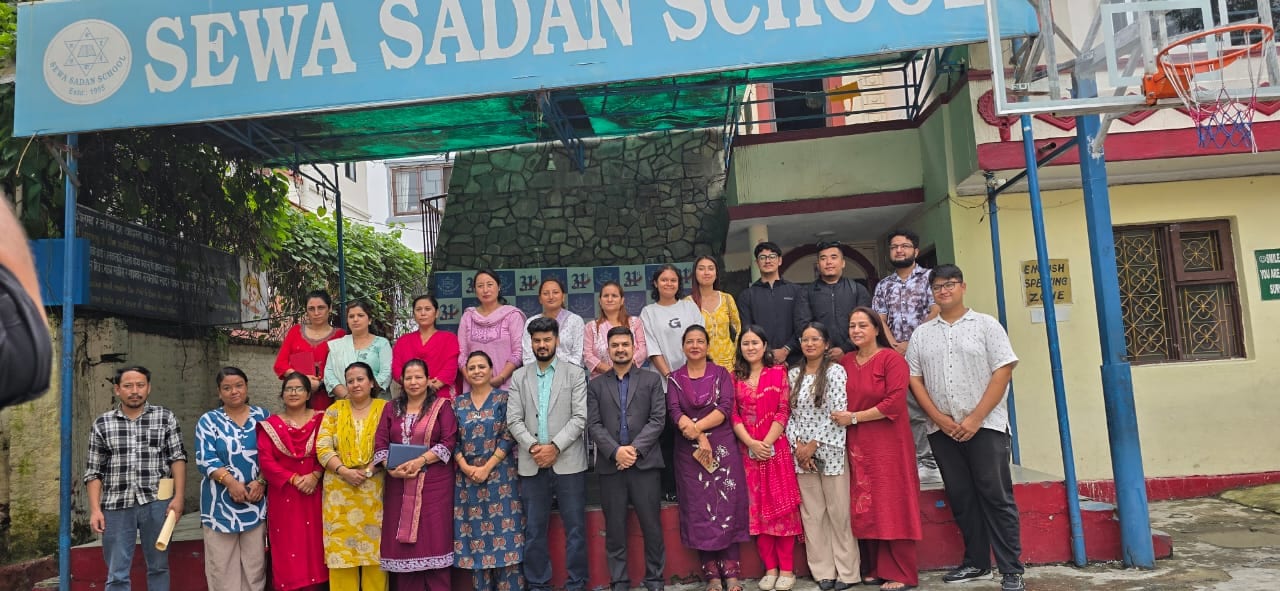
Over the past few months I have been visiting community schools to train teachers on how to use artificial intelligence (AI) in their teaching. Through Sankhya AI's "AI for Teachers" programme, I have now worked with more than 70 teachers in 6 schools across 3 districts, including Sewa Sadan School, Durbar School and Pashupati Mitra School. This article is what we did, what I saw, and what I think it means for AI in education in Nepal.
Why I started
I am an economist by training, and I have been teaching bachelor students for the last 3 years. In my own classes I see students using AI tools every day. Some use them well, to understand a concept or check their thinking. Others use them only to finish an assignment quickly.
When I looked at our school system, the picture was different. Most teachers in community schools had never been shown what AI can do. There was no clear guidance on what they should or should not do with it.
As an economist, this worries me for a simple reason. The students in our classrooms today will enter a job market where AI works alongside people, and where many tasks inside jobs will change. If our schools are not preparing them for that, we are building a skills gap that will be hard to close later. At the same time, we are not using what AI can already do for teaching and learning.
What we did in the workshops
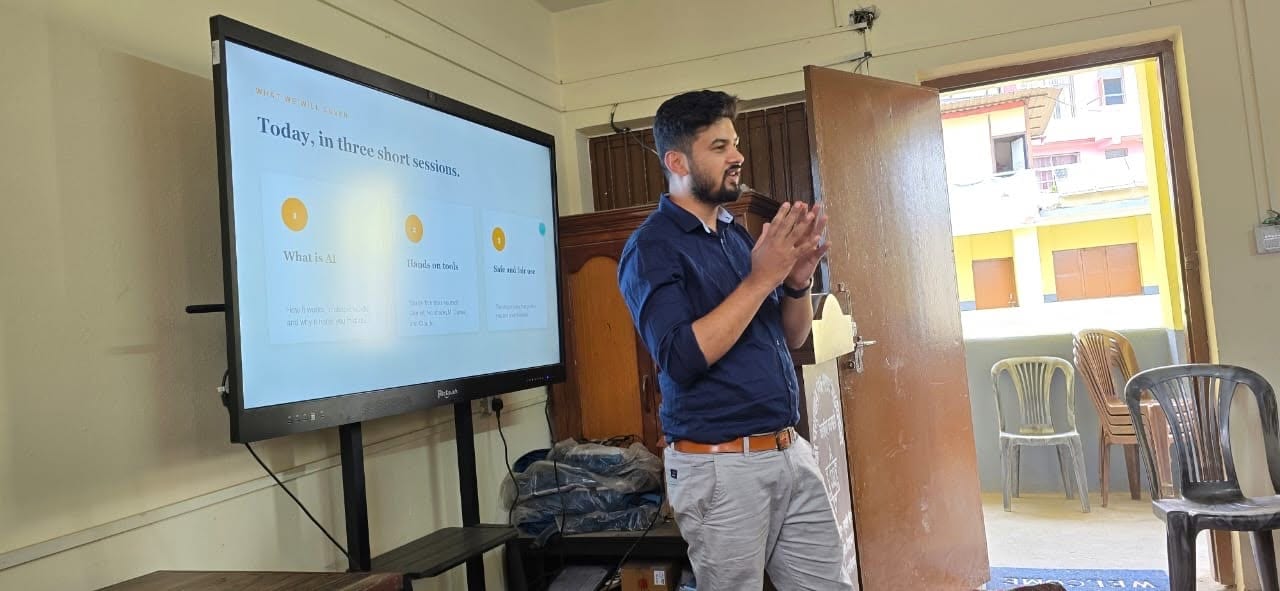
Each workshop runs in three short sessions.
First, what AI is and how it works, in simple language. Teachers need to understand that a tool like ChatGPT or Gemini predicts words, and that it can be confidently wrong. Without this, teachers either fear AI or trust it too much.
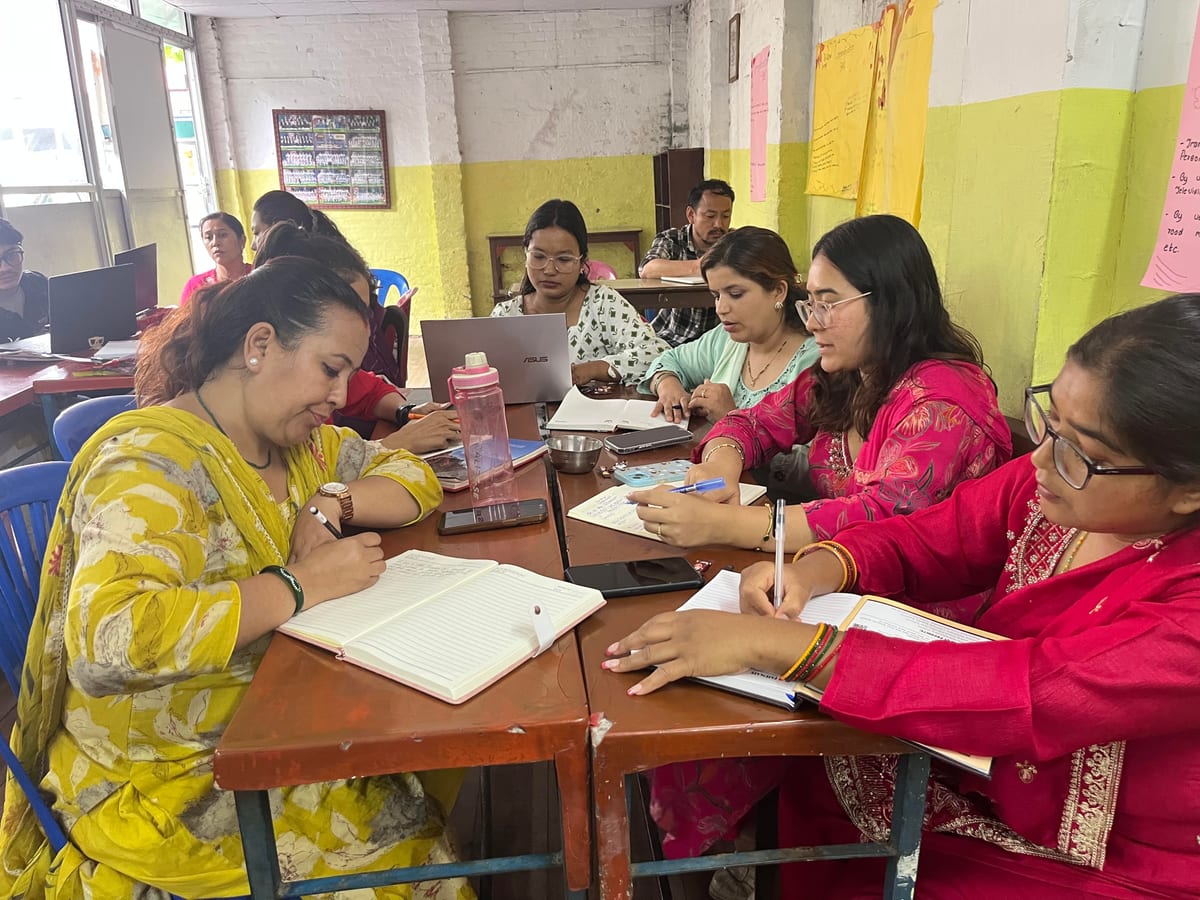
Second, hands-on practice with the tools. We used ChatGPT, Gemini, Gemini Gems, Gemini Notebook and Claude. Teachers did not watch a demonstration and go home. They prepared lesson plans, question papers and teaching materials for their own subjects during the session.
Third, safe and fair use. How to check what AI produces, why students' personal information should never go into an AI tool, and how to talk to students honestly about AI.
In one school, Sewa Sadan, we went further and built a Class 10 Mathematics assistant inside Gemini. The teacher sets it up once with the CDC curriculum and the teacher's guide. After that, one sentence produces a full 45-minute session: objectives, an opening hook based on a real Nepali situation, a slide outline, and SEE-style homework with an answer key.
What surprised the teachers
I expected the lesson plan exercise to be the highlight, because it saves the most time. Teachers did appreciate it. One teacher told me she used to spend two to three hours planning a single lesson, making charts and teaching materials by hand. With AI, that came down to minutes.
But the strongest reaction came from something else. When I showed the solar system as a 3D model on the screen, the room changed. It was simple and it looked good, and you could turn it and look at each planet. Teachers stopped asking "how will this save my time?" and started asking "how will this help my students understand?"
For me, this was the most important moment of the workshops. The real value of AI in our classrooms is not only in paperwork. It is in how a concept gets explained to a student who did not understand it the first time.
Three lessons
1. Teachers are curious, not resistant. There is a common belief that teachers in government schools resist technology. That is not what I found. Most teachers I met were curious. They wanted to know which tools to use and how far to trust them. This matches a recent study by the Ministry of Education and Sports and British Council Nepal, which surveyed 815 teachers in all seven provinces and found that 76 % had already used generative AI, mostly learning on their own. The problem is not interest. It is support.
2. One workshop is not enough. A one-day session gives teachers a start. Apart from that, they need someone to ask when they get stuck, and examples from their own subject. This is why we stay in touch with the teachers we trained through WhatsApp and Viber groups. There we share how teachers can use AI, how to use it responsibly, and what other schools and universities are trying. Every teacher also gets a practical handbook with 30 ready prompts to continue on their own.
3. Teachers need guidance, not only tools. Teachers asked me practical questions. Two came up again and again: how much can we trust AI, and which tools are best for teachers. These should not be left for each teacher to answer alone. Nepal has a National AI Policy 2082, but there is still no simple guidance a teacher can follow inside the classroom.
What I think should happen next
Based on these schools, I would suggest four things.
- Simple interim guidance for schools. One or two pages that tell teachers what is allowed, what to avoid, and how to protect students' data. This can come before a full national standard.
- Follow-up after training. Peer groups, short refresher sessions and mentoring, so teachers keep using what they learnt.
- Focus on learning, not only paperwork. Saving time on lesson plans is good. The bigger value is in explaining concepts better and reaching students who are struggling.
- Connect school learning with future skills. Students should learn how to work with AI, how to question its answers, and how to do the things AI cannot do well. This is how we prepare them for the job market they will actually enter.
What comes next
Over the coming months I will share what we learn every week, on this blog and on LinkedIn. We are measuring change with short surveys before the training, after it, and one month later, and I will publish the results. I will also share free prompts and guides for teachers in English and Nepali.
If you are a teacher, headteacher, education officer or researcher and would like to work together, or would like a workshop for your school, please get in touch through my website.
Free resource: download AI for Teachers: A Practical Handbook, with step-by-step guides and 30 ready prompts for Nepali teachers: https://indragiri.com.np/projects/
Source for the national figures: "Nepali teachers have found their way to AI. Can our education system keep up?", The Kathmandu Post, 2 October 2026.